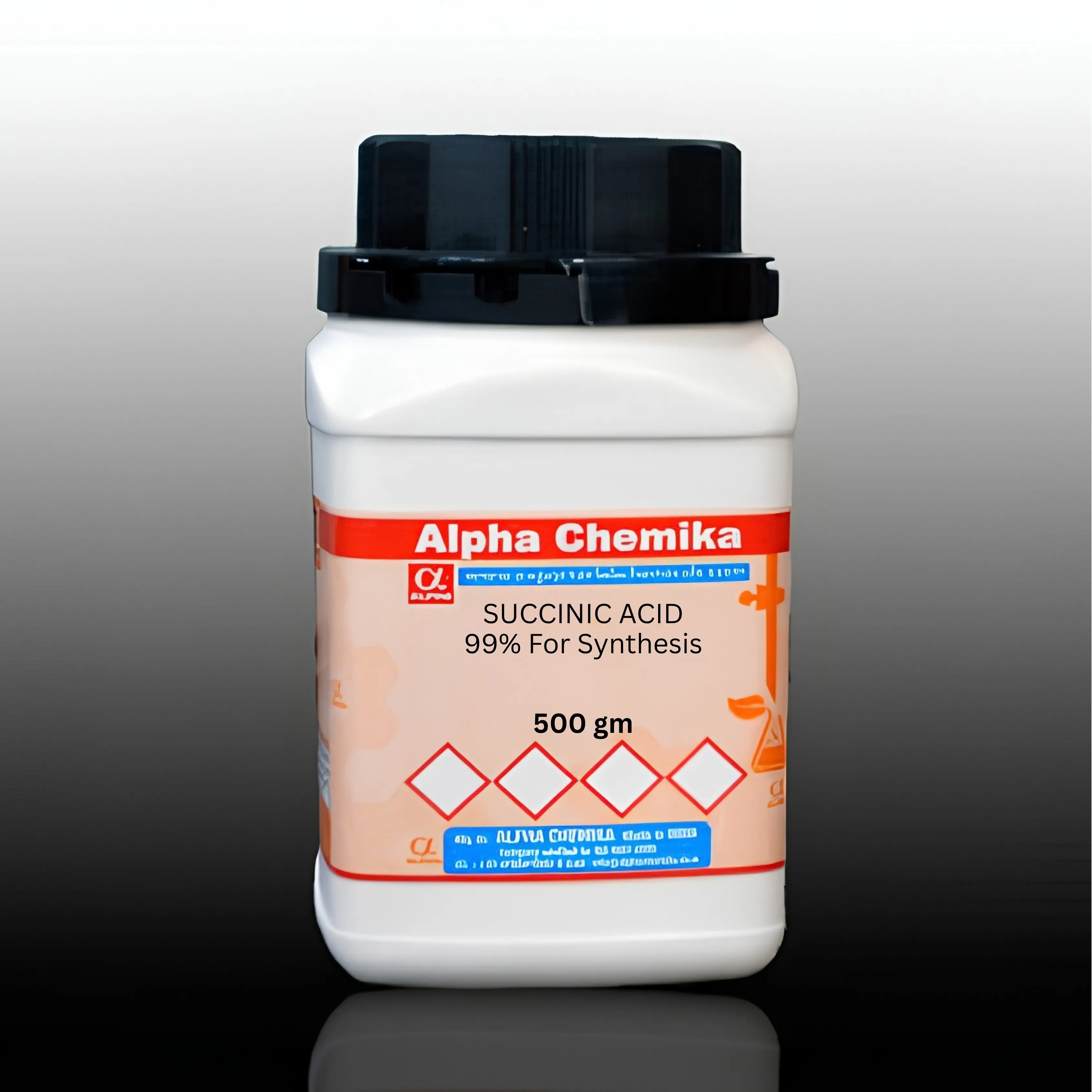


Succinic Acid
- CAS Number
- 110-15-6
- HSN Code
- 29171930
- Molecular Formula
- C4H6O4
- Catalogue Number
- AL01474
- Purity
- ≥ 99%
- Molecular Weight
- 118.09 g/mol
Complies with : IP | BP | USP | EP | ACS
 ISO 9001
ISO 14001
GMP
COA with every batch
ISO 9001
ISO 14001
GMP
COA with every batch
Key Properties


Succinic acid (for synthesis) is a fundamental dicarboxylic acid, a key citric acid cycle intermediate widely used in polymer and food chemistry. It is a colorless to white crystalline solid that plays a significant role in various biochemical processes and industrial applications. Succinic acid is notable for its versatility, serving as a building block for the synthesis of biodegradable polymers and as a food additive. Its high purity grade of 99% makes it suitable for synthesis applications, ensuring minimal impurities that could affect chemical reactions.
Also known as Butanedioic acid, Amber acid.
- Catalogue No.
- AL01474
- CAS Number
- 110-15-6
- Molecular Formula
- C4H6O4
- Molecular Weight
- 118.09 g/mol
- HSN Code
- 29171930
- Grade
- 99%
- Product Form
- Substance
Succinic acid appears as a white crystalline powder with a characteristic odor. It has a melting point of approximately 185 °C and a boiling point of 235 °C. The density of succinic acid is about 1.57 g/cm³ at 20 °C. It is highly soluble in water, with a solubility of approximately 1 g in 0.5 mL of water at 20 °C, and it is also soluble in alcohol and ether. The pH of a 1% aqueous solution is around 3.0, indicating its acidic nature.
- Appearance
- White crystalline powder
- Shelf Life
- 2 years
- Packaging
- Available in 500 g and 1 kg containers
- Storage
- Store in a cool, dry place away from direct sunlight.
1.1 — Product identifier
- Chemical Name
- Succinic Acid
- Catalogue No.
- AL01474
- Product form
- Substance
- CAS Number
- 110-15-6
- EC Number
- 203-740-4
- Grade
- 99%
- EC Index Number
- 607-095-00-7
- Chemical Formula
- C4H6O4
- HSN Code
- 29171930
- Synonyms
- Butanedioic acid, Amber acid
1.2 — Relevant identified uses of the substance or mixture and uses advised against
- Use of the substance/mixture
- Used in the synthesis of polymers, food chemistry, and as a biochemical reference standard.
- Uses advised against
- Not specified
1.3 — Details of the supplier of the safety data sheet
- Company identification
- Address:- 102, B wing, Savgan Heights, RTO Lane,Andheri (W), Mumbai-400 053Maharashtra, India.
1.4 — Emergency Contact Details
- Phone / e-Mail
- Phone : +91 22 26317055 Mobile : +91 9820385757 e-mail : info@alphachemika.co.in
2.3 — Other hazards
- Other hazards
- None identified.
3.1 — Substance
- Name
- Succinic Acid
- CAS No.
- 110-15-6
4.1 — Description of first aid measures
- First-aid measures after inhalation
- Move to fresh air. If symptoms persist, seek medical attention.
- First-aid measures after skin contact
- Wash with soap and water. If irritation occurs, seek medical attention.
- First-aid measures after eye contact
- Rinse cautiously with water for several minutes. Remove contact lenses if present and easy to do. If irritation persists, seek medical attention.
- First-aid measures after ingestion
- Rinse mouth. Do not induce vomiting. Seek medical attention if symptoms occur.
4.2 — Most important symptoms and effects, both acute and delayed
- Symptoms relating to use
- May cause irritation to skin, eyes, and respiratory tract.
4.3 — Indication of any immediate medical attention and special treatment needed
- General information
- Treat symptomatically. Show this safety data sheet to the treating physician.
5.1 — Extinguishing media
- Suitable extinguishing media
- Water spray, carbon dioxide, dry chemical powder, foam.
- Unsuitable extinguishing media
- Not specified
5.2 — Special hazards arising from the substance or mixture
- Special procedures
- Combustible material; may produce toxic fumes when burned.
5.3 — Advice for firefighters
- Protection during firefighting
- Do not enter fire area without proper protective equipment, including respiratory protection.
6.1.1 — For non-emergency personnel
- Emergency procedures
- Contain spill and collect using appropriate methods. Dispose of in accordance with local regulations.
6.3 — Methods and material for containment and cleaning up
- Methods for cleaning up
- Use appropriate protective equipment. Sweep up and place in a suitable container for disposal.
6.4 — Reference to other sections
- Reference
- Not specified
7.1 — Precautions for safe handling
- Precautions for safe handling
- Avoid contact with skin and eyes. Use in a well-ventilated area.
- Hygiene measures
- Wash hands and other exposed areas with mild soap and water before eating, drinking or smoking and when leaving work.
7.2 — Conditions for safe storage, including any incompatibilities
- Storage conditions
- Store in a cool, dry place, away from incompatible materials.
8.2 — Exposure controls
- Hand protection
- Protective gloves (e.g. nitrile rubber)
- Eye protection
- Chemical safety goggles or safety glasses
- Skin and body protection
- Wear suitable protective clothing
- Respiratory protection
- Use appropriate respiratory protection if ventilation is inadequate.
9.1 — Information on basic physical and chemical properties
- Physical state
- Solid
- Colour
- White
- Odour
- Characteristic
- Odour threshold
- Not specified
- pH value
- 3.0 (1% solution)
- Relative evaporation rate (butylacetate=1)
- Not specified
- Melting point
- 185 °C
- Freezing point
- Not specified
- Boiling point
- 235 °C
- Flash point
- Not specified
- Auto-ignition temperature
- Not specified
- Decomposition temperature
- Not specified
- Flammability (solid, gas)
- Combustible
- Vapour pressure
- Not specified
- Relative vapour density at 20°C
- Not specified
- Density
- 1.57 g/cm³
- Solubility
- Soluble in water, alcohol, and ether
- Log Pow
- Not specified
- Viscosity, kinematic
- Not specified
- Viscosity, dynamic
- Not specified
- Explosive properties
- Not explosive
- Oxidising properties
- Not oxidizing
- Explosive limits
- Not specified
10.1 — Reactivity
- Reactivity
- Stable under normal conditions. Avoid strong oxidizing agents.
10.2 — Chemical stability
- Chemical stability
- Stable under recommended storage conditions.
10.3 — Possibility of hazardous reactions
- Possibility of hazardous reactions
- No dangerous reactions known under normal conditions of use.
10.4 — Conditions to avoid
- Conditions to avoid
- Avoid contact with incompatible materials and excessive heat.
10.5 — Incompatible materials
- Incompatible materials
- Strong oxidizing agents, strong bases.
10.6 — Hazardous decomposition products
- Hazardous decomposition products
- Not specified
11.1 — Information on toxicological effects
- Acute toxicity
- LD50 (oral, rat) > 5000 mg/kg.
- Skin corrosion/irritation
- May cause mild irritation.
- Serious eye damage/irritation
- May cause mild irritation.
- Respiratory or skin sensitisation
- Not a sensitizer.
- Germ cell mutagenicity
- Not classified
- Carcinogenicity
- Not classified
- Specific target organ toxicity (single exposure)
- Not classified as a specific target organ toxicant.
- Specific target organ toxicity (repeated exposure)
- Not classified
12.1 — Toxicity
- Toxicity information
- Not specified
12.2 — Persistence - degradability
- Persistence - degradability
- Not specified
12.3 — Bioaccumulative potential
- Bioaccumulative potential
- Not specified
12.4 — Mobility in soil
- Mobility in soil
- Not specified
12.6 — Other adverse effects
- Environmental precautions
- Not specified
13.1 — Waste treatment methods
- Additional Info
- Dispose of contents/container in accordance with local, regional, national and international regulations.
14.1 — UN number
- UN-No. (ADR)
- Not assigned
- UN-No. (IMDG)
- Not assigned
- UN-No. (IATA)
- Not assigned
- UN-No. (ADN)
- Not assigned
- UN-No. (RID)
- Not assigned
14.2 — UN proper shipping name
- Proper Shipping Name (ADR)
- Not classified as dangerous goods
- Proper Shipping Name (IMDG)
- Not classified as dangerous goods
- Proper Shipping Name (IATA)
- Not classified as dangerous goods
- Proper Shipping Name (ADN)
- Not classified as dangerous goods
- Proper Shipping Name (RID)
- Not classified as dangerous goods
14.3 — Transport hazard class(es)
- Transport hazard class(es)
- Not applicable
14.4 — Packing group
- Packing group (ADR)
- Not applicable
- Packing group (IMDG)
- Not applicable
- Packing group (IATA)
- Not applicable
- Packing group (ADN)
- Not applicable
- Packing group (RID)
- Not applicable
14.5 — Environmental hazards
- Dangerous for the environment
- Not specified
- Marine pollutant
- Not specified
- Other information
- No supplementary information available
15.1 — Safety, health and environmental regulations/legislation specific for the substance or mixture
- 15.1.1 EU-Regulations
- Not specified
Succinic acid is widely used in the production of bio-based polyesters, which are utilized in the manufacture of biodegradable plastics and fibers. It serves as a precursor for various chemical syntheses, including the production of solvents, plasticizers, and food additives. In the pharmaceutical industry, succinic acid is used as a reference standard in citric acid cycle metabolism research, aiding in the study of energy production in living organisms. Additionally, it finds applications in the food industry as a flavoring agent and acidity regulator.
ISO 9001
ISO 14001
GMP
COA with every batch
- Batch Number
- AL-2026-AL01474
- Manufacturing Date
- September-2026
- Expiry Date
- September-2031
- Molecular Weight
- 118.09 g/mol
| Test | Standard | Observed |
|---|---|---|
| Assay | ≥ 99% | 99.5% |
| Melting Point | 185 °C | 186 °C |
| Moisture Content | ≤ 0.5% | 0.3% |
| Residue on Ignition | ≤ 0.1% | 0.05% |
| Related Substances | None detected | None detected |
The above product is expected to comply with 99% grade specification.
Technical Data Sheet
| Grade | Assay/Purity | Melting/Boiling Point | Moisture/LOD | Residue on Ignition | Related Substances | Solubility |
|---|---|---|---|---|---|---|
| 99% | ≥ 99% | 185 °C (melting) | ≤ 0.5% | ≤ 0.1% | None detected | Soluble in water |
Related Products
View AllWhy buy from Alpha Chemika




What Our Scientific & Industrial Customers Say

“Speedy delivery, professional staff.”
“One shop stop for all laboratory chemicals requirements.”
“Exactly as advertised.”
“Alpha Chemika products are of excellent quality. Highly satisfied.”
“From ordering to shipping, every course of action was smooth. Timely delivery.”
“Completely satisfied with the products and services.”
“Speedy delivery, professional staff.”
“One shop stop for all laboratory chemicals requirements.”
“Exactly as advertised.”
“One shop stop for all laboratory chemicals requirements.”
“Exactly as advertised.”
“Alpha Chemika products are of excellent quality. Highly satisfied.”
“Exactly as advertised.”
“Alpha Chemika products are of excellent quality. Highly satisfied.”
“From ordering to shipping, every course of action was smooth. Timely delivery.”
“Alpha Chemika products are of excellent quality. Highly satisfied.”
“From ordering to shipping, every course of action was smooth. Timely delivery.”
“Completely satisfied with the products and services.”
“From ordering to shipping, every course of action was smooth. Timely delivery.”
“Completely satisfied with the products and services.”
“Speedy delivery, professional staff.”
“Completely satisfied with the products and services.”
“Speedy delivery, professional staff.”
“One shop stop for all laboratory chemicals requirements.”
 FAQs
FAQs
Common Questions About Laboratory Chemicals & Solutions
Find answers to common questions about laboratory chemicals, product selection, documentation, ordering, and technical support. Whether you are sourcing chemicals for research, testing, education, manufacturing, or industrial applications, these FAQs can help you make informed purchasing decisions.
Alpha Chemika offers a wide range of laboratory chemicals, reagents, solvents, and specialty products for research, testing, educational, pharmaceutical, and industrial applications.
Product selection depends on factors such as application, required purity, grade, specifications, and intended use. Our team can help you identify suitable products based on your technical requirements.
Yes. Relevant product information and technical documentation can be provided to help you evaluate products for quality, handling, compliance, and application requirements.
Yes. You can share your product list, required quantities, specifications, and delivery requirements with our team for a tailored quotation.
Yes. We support requirements from research laboratories, educational institutions, pharmaceutical companies, manufacturers, distributors, and other scientific and industrial organizations.
Connect with Us for Your Requirements
Have a specific product requirement or need help finding the right chemical for your application? Share your requirements with our team, and we will help you identify suitable products, specifications, quantities, and procurement options.